Busan IFC Mall (2F–4F) · 6,600㎡ One-Day Comprehensive Health Screening & Specialist Care · International Patient Concierge

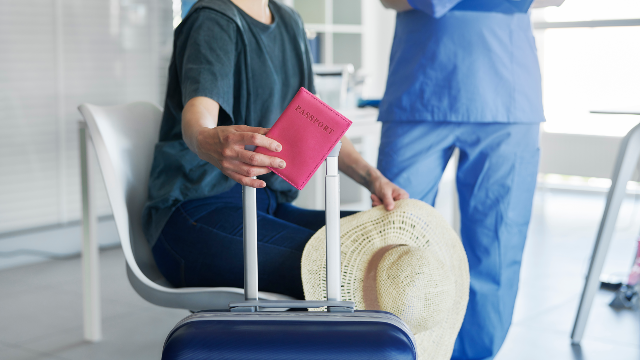
Medical Guide
Traveling From the US to Busan for a Health Checkup
A Busan health checkup travel guide for US patients: flight routes, the KTX and domestic connection, BIFC station access, jet lag and arrival-day timing.
Schedule a ConsultationTraveling From the US to Busan for a Health Checkup: A Complete Logistics Guide
Medically reviewed by Dr. Baik Seung Hyuk, M.D., Ph.D., FASCRS, Hospital Director
The appointment is the easy part. What trips people up is everything between their front door and the elevator at IFC Mall. This Busan health checkup travel guide covers the journey itself: which airport to fly into, how to get from that airport to Busan, how to reach the clinic once you are in the city, and how to arrange those pieces so that you arrive at an early morning screening slot rested enough for the day to go well. Yonsei Mirae IFC Medical Center sits in Busan, not Seoul, and that single geographic fact shapes almost every decision below.
Start From the Clinic and Work Backward
Plan this trip in reverse. The fixed point is the appointment, and everything else arranges itself around it.
Yonsei Mirae IFC Medical Center is at 133 Jeonpo-daero in Nam-gu, Busan, occupying the second through fourth floors of IFC Mall. The BIFC subway station, named for the Busan International Finance Center, sits immediately alongside. Health screening runs Monday through Friday from 7:30 AM to 4:30 PM and on Saturday from 7:30 AM to 12:30 PM, in Korean Standard Time. The center is closed on Sundays and on public holidays.
Two things follow from that. First, screening starts early, which means your body needs to be functioning at an hour that will feel like the middle of the night if you have just crossed the Pacific. Second, the Saturday window closes at midday, so a Saturday appointment leaves far less room for a slot to shift. A weekday appointment is the more forgiving choice for a traveler.
Korea runs on Korean Standard Time, UTC+9. Depending on the season that is roughly 13 to 14 hours ahead of the US East Coast and 16 to 17 hours ahead of the West Coast. Build your mental model of the trip in Korean time from the beginning rather than converting on the fly.
The Two Ways Into Busan
There is no single correct route. There are two, and the right one depends on where you are flying from and how much connection risk you are willing to carry.
Route one: fly into Incheon International Airport near Seoul, then continue to Busan. Incheon carries the widest range of nonstop service from US cities, so this is the route most American travelers end up on. It requires a second leg of roughly three hours, by rail or by domestic flight, at the end of an already long day.
Route two: fly into Gimhae International Airport in Busan itself. Gimhae is Busan's airport, at 108 Gonghangjinip-ro in Gangseo-gu. There is no nonstop service from the United States, so this route means connecting somewhere in Asia. In exchange, you land in the city where your appointment is and skip the domestic transfer entirely.
Neither is obviously better. Route one usually means fewer flights and a longer ground journey. Route two usually means an extra flight and a shorter ground journey. What matters is that you choose deliberately, because the two produce very different arrival times.
Route One in Detail: Incheon to Busan
Incheon is a major hub and, as the Korea Tourism Organization notes, it connects onward to cities across the country, not only to Seoul. You have two realistic ways to cover the remaining distance.
By high-speed rail
The KTX runs south from Seoul Station to Busan Station, and the Korea Railroad Corporation, which operates as KORAIL, is the national rail operator. Busan Metropolitan City's own visitor information points travelers to KORAIL's website for schedules and notes that online reservations are available in English along with several other languages, with a dedicated inquiry line for foreign travelers.
Getting from the airport to Seoul Station is the first step. The Korea Tourism Organization describes the Airport Railroad, known as AREX, as the fastest connection between Incheon and Seoul Station. Its express service is nonstop and takes approximately 43 minutes from Terminal 1 and approximately 51 minutes from Terminal 2. The all-stop service on the same line takes approximately 59 minutes from Terminal 1 and approximately 66 minutes from Terminal 2, and it calls at major stations along the way.
Add the walk between terminal and platform, the wait for your train, and the KTX journey itself, and this leg realistically consumes most of an afternoon. Book the rail ticket in advance if your arrival is close to the evening, because options thin out later in the day.
By domestic flight
The alternative is to connect onward by air. Domestic services to Busan operate from Gimpo International Airport in Seoul rather than from Incheon, which means a transfer between the two airports unless your itinerary is ticketed as a single through connection. The Korea Tourism Organization notes that AREX trains, subway services and limousine buses all run between Gimpo and central Seoul, and that limousine bus routes connect Gimpo directly with Incheon.
This route can be faster than rail, but it introduces a second airport, a second security screening and a second chance for a delay to cascade. If you choose it, leave generous margin. Missing the last domestic departure of the evening is a considerably worse problem than arriving in Busan late by train.
By intercity bus
There is a third option that is easy to overlook. Busan Metropolitan City lists intercity bus service from Incheon International Airport arriving at both the Busan Dongbu Inter-City Bus Terminal, located at Nopo Station on Metro Line 1, and the Seobu Inter-City Bus Terminal at Sasang Station on Metro Line 2. It is slower than rail, but it runs direct from the airport and requires no transfer in Seoul, which some travelers prefer after a long flight.
Route Two in Detail: Arriving at Gimhae
If you route through an Asian hub and land at Gimhae, the remaining journey is short. The Korea Tourism Organization describes three ways into the city.
- Light rail. Gimhae is connected to the Busan–Gimhae Light Rail Transit through Airport Station. Travelers transfer at Sasang Station onto Busan Metro Line 2, from which the rest of the network opens up. The Korea Tourism Organization gives approximate travel times of around 30 minutes to Seomyeon, 50 minutes to Gwangalli and 70 minutes to Haeundae.
- Limousine bus. Airport limousine buses serve the Seomyeon–Bujeon and Haeundae–Gijang corridors. Boarding is at Platform 3, between Gates 2 and 3 on the first floor of the international terminal. Tickets must be bought in advance at the counter near Gate 4; cash and transportation cards are not accepted when boarding.
- Taxi. Standard, deluxe and jumbo taxis serve major areas of Busan from a stand across from the bus stop on the second floor of the international terminal. The Korea Tourism Organization estimates roughly 40 minutes to the Seomyeon or Bujeon area.
With luggage and jet lag, a taxi is the least demanding of the three. With a light bag and a functioning brain, the light rail is entirely manageable.
The Last Mile: Reaching IFC Mall
Whichever way you arrive in Busan, the final approach is the simplest part of the trip.
The center is adjacent to BIFC station, so the subway delivers you essentially to the door. Busan Metropolitan City describes a Metro network of four lines, each distinguished by color, operated by Busan Transportation Corporation. Destination announcements are made in Korean, English, Japanese and Chinese, and transfer stations are signaled by a distinctive bird sound in addition to the spoken announcements. For a traveler who does not read Korean, this is a genuinely low-stress system.
Taxis are the other option, and the city distinguishes between general taxis, which you can hail on the street or find at a stand, and deluxe and jumbo taxis, which are black with a yellow roof sign and are commonly found at airports, hotels and tourist areas. Jumbo taxis carry larger groups and more luggage. Busan also operates a branded call taxi service, Deungdae Call, reachable at 051-600-1000, with interpretation available around the clock in English, Chinese, Japanese and Russian. Keep that number somewhere you can find it quickly.
One practical note for appointment morning: a subway trip takes a predictable amount of time and a taxi does not, because traffic does not care about your schedule. If your slot is early, the subway is the safer instrument.
Entry Paperwork to Settle Before You Fly
Entry rules change, and this is the one part of your planning where you should verify rather than trust any article, this one included. Confirm everything below with the Korean embassy or consulate responsible for your area before you finalize travel, and treat nothing here as a promise about whether any particular traveler will be admitted.
The US Department of State's country information page for South Korea is the appropriate starting point for American citizens and notes that a visa is not required for stays of 90 days or less for tourism or business, and that a valid passport is required.
Three further items are worth understanding:
- K-ETA exemption. The temporary exemption from the Korea Electronic Travel Authorization for eligible nationalities, US citizens among them, runs through 31 December 2026.
- K-ETA resuming. The authorization requirement is scheduled to return on 1 January 2027, which matters if your trip straddles that date or falls after it.
- e-Arrival Card. Travelers entering without a K-ETA are required to complete Korea's digital entry declaration. The Ministry of Justice operates the e-Arrival Card service, which is completed online and can be submitted within the three days before arrival. The process runs through terms agreement with an email address, passport details, travel itinerary, a review step and submission. The service also provides a navigator tool that tells you whether a declaration is required in your specific case.
Separately, Korea operates a C-3-3 short-term visa category for foreign nationals traveling for medical treatment or recuperation, and for an accompanying caregiver. Whether it applies to a preventive screening trip is a question for the consulate, not for a website. Again: confirm current requirements with the Korean embassy or consulate before you book anything you cannot change.
Jet Lag Is the Real Scheduling Problem
Everything above is solvable with a calendar. This part is biology, and it deserves more respect than most travelers give it.
The CDC's Yellow Book describes jet lag as a mismatch between a traveler's internal circadian rhythms and the time of day at the destination. It draws a useful threshold: when three or fewer time zones are crossed, symptoms such as tiredness are more likely to be ordinary travel fatigue than true jet lag. A US to Korea trip crosses far more than three, which puts you firmly in jet lag territory rather than tired-after-a-flight territory.
The symptoms the CDC associates with it are exactly the ones you do not want on screening morning: disturbed sleep, impaired thinking, daytime sleepiness, general malaise and gastrointestinal upset. That last item is worth pausing on. Digestive disturbance from a disrupted body clock, arriving on top of an overnight fast, is an unpleasant combination at 7:30 in the morning.
The CDC also notes that light exposure and social contact after arrival influence the timing of internal rhythms, and that a traveler staying more than two days should try to shift to the local sleep and wake schedule as quickly as possible. In practice that means daylight, meals and activity on local time from the moment you land, rather than a long afternoon nap that feels wonderful and wrecks the following night.
Why the collision is specific
Three constraints meet on the same morning. Screening begins at 7:30 AM Korean time. The center asks patients to fast after 9 PM the night before, with additional preparation for certain procedures. And your body, on East Coast time, thinks 7:30 AM in Busan is somewhere around late afternoon or evening of the previous day.
None of those three is negotiable on the day. All three are manageable if you arrive early enough to let the first two stop fighting the third.
Sequencing Arrival Day Against Appointment Day
The single most useful rule in this entire article: do not schedule the checkup for the day you land.
A workable sequence looks like this:
- Arrival day. Land, travel to Busan, check into your accommodation. Get outside in daylight if any remains. Eat a normal meal at a normal local hour. Go to bed at a plausible local bedtime rather than when you feel tired.
- The day between. Stay on local time. Daylight in the morning, normal meals, light activity. Do not nap into the evening. Confirm your appointment time and your route to BIFC station. Observe the overnight preparation instructions you were given.
- Appointment day. Wake on local time, travel by subway, and leave earlier than you think necessary. A comprehensive checkup takes approximately 3.5 to 4 hours within the center's one-day, one-stop system, so plan the rest of the day loosely.
If your itinerary genuinely cannot accommodate a full buffer day, an evening arrival with an appointment two mornings later is the minimum that gives your body any chance. Arriving and screening within the same 24 hours produces a version of you that is fasting, disoriented and being asked to answer medical history questions accurately.
One more scheduling note: if sedation is part of your program, nothing requiring judgment should be scheduled for the remainder of that day, including onward travel. Ask about this when you confirm the appointment rather than discovering it afterward.
Health Preparation Before You Leave Home
Two items belong on the pre-departure list alongside passport and tickets.
The CDC's Travelers' Health destination page for South Korea sets out destination-specific health guidance, including recommended vaccines and any current health notices. It is worth reading a few weeks before departure rather than a few days, since some vaccines need lead time.
The CDC also advises travelers planning medical care abroad to discuss the plan with their own clinician at home in advance, to check what their domestic health coverage does outside the United States, and to consider supplemental medical and medical evacuation coverage. For a screening trip, the most valuable outcome of that conversation is usually a clear list of what you want examined and copies of any prior results worth bringing.
Practical items to assemble before you fly:
- Passport, plus a photograph or scan stored separately.
- Your appointment confirmation and the center's contact details.
- A current list of the medicines you take. A separate guide covers exactly how to write it.
- Copies of relevant prior test results.
- A note of any allergy or condition that might affect an examination.
- The Deungdae Call number and your accommodation address written in a form you can show a driver.
Once You Are in Busan
The center operates a dedicated international medical center with a foreign-patient coordinator, and English-speaking assistance is available from consultation through recovery. Interpretation is offered in English and Chinese, and examination reports, doctor's notes and medical records can be prepared in those languages, which is what makes the results useful to your physician back home.
If anything about your arrival changes — a delayed connection, a missed train, a slot you can no longer make — say so as early as you can through the center's contact page. Scheduling has more flexibility before the day than on it. The center opened in 2021. It holds Registered Medical Institution for Attracting Foreign Patients status with Korea's Ministry of Health and Welfare, and it is licensed under the Medical Service Act. Its history and mission are described on the about us page, and accounts written by earlier visitors sit under customer reviews.
Some travelers cannot be screened as planned. Restrictions apply to children, to anyone who is pregnant or might be, and to certain physical and mental health conditions. Raise anything in that territory when you first make contact rather than after you land, because it may change what can be scheduled and therefore what your trip needs to look like.
The Bottom Line
- There are two practical routes from the United States: fly into Incheon and continue to Busan by KTX, domestic flight from Gimpo, or intercity bus; or connect through an Asian hub into Gimhae, Busan's own airport.
- From Gimhae, the Korea Tourism Organization describes light rail via Airport Station with a transfer at Sasang onto Metro Line 2, limousine buses toward Seomyeon–Bujeon and Haeundae–Gijang, and taxis reaching Seomyeon in roughly 40 minutes.
- The clinic sits beside BIFC subway station at IFC Mall, and Busan's four-line Metro announces destinations in English, which makes the subway the most predictable way to arrive on appointment morning.
- The CDC's Yellow Book treats crossing more than three time zones as genuine jet lag rather than travel fatigue, and its symptoms collide directly with a 7:30 AM screening start and an overnight fast.
- Do not schedule the checkup for your arrival day, and confirm current entry requirements, including the K-ETA exemption timeline and the e-Arrival Card, with the Korean embassy or consulate before you book.
Frequently Asked Questions
Should I fly into Incheon or Gimhae?
Incheon offers the widest choice of nonstop service from US cities but leaves a further journey of roughly three hours to Busan. Gimhae puts you in Busan directly but requires a connection somewhere in Asia. Pick based on which you would rather manage while tired: an extra flight, or a long ground leg at the end of a long day.
What is the most reliable way from Incheon to Busan?
High-speed rail is the option with the fewest moving parts. The Korea Tourism Organization describes the AREX express service reaching Seoul Station in approximately 43 minutes from Terminal 1 and approximately 51 minutes from Terminal 2, from which KTX services run south to Busan. Korea Railroad Corporation reservations can be made online in English ahead of your trip.
How do I actually get to the clinic on the morning of my appointment?
Take the subway to BIFC station, which is adjacent to the building. Busan Metro's four lines are color-coded and announce destinations in English among other languages, and the journey time is predictable in a way that a taxi ride through morning traffic is not. Leave earlier than you think you need to.
Do I need a visa to travel to Korea for a checkup?
The US Department of State notes that a visa is not required for stays of 90 days or less for tourism or business, and a valid passport is required. Korea also operates a C-3-3 short-term visa category for medical treatment or recuperation and for an accompanying caregiver. Confirm what applies to your own trip with the Korean embassy or consulate responsible for your area before booking.
What is the e-Arrival Card and do I have to complete one?
It is Korea's digital entry declaration, operated by the Ministry of Justice. It is completed online and can be submitted within the three days before arrival, with the process running from terms agreement through passport details and itinerary to final submission. The service includes a navigator tool that indicates whether a declaration is required in your circumstances, and the embassy or consulate can confirm current rules.
How badly will jet lag affect an early morning appointment?
Meaningfully, if you do not plan around it. The CDC's Yellow Book describes jet lag as a mismatch between internal rhythms and destination time, with symptoms including disturbed sleep, impaired thinking, daytime sleepiness and gastrointestinal upset. It advises shifting to the local sleep and wake schedule as quickly as possible, using daylight and normal social timing after arrival.
Can I schedule the checkup for the day I land?
It is strongly inadvisable. Screening begins at 7:30 AM Korean time, an overnight fast is expected beforehand, and your body will still be on US time. At least one full day between landing and the appointment gives all three a chance to reconcile.
What should I do if my flight is delayed and I will miss my slot?
Contact the center as soon as you know, rather than after the appointment time has passed. Health screening runs Monday through Friday from 7:30 AM to 4:30 PM and Saturday until 12:30 PM, and the center is closed Sundays and public holidays, so a delayed weekend arrival has fewer alternatives than a weekday one.
This article is for general informational purposes and does not constitute individualized medical advice, and it is not a self-diagnosis tool. Screening options, test selection, and the meaning of any result can only be determined through consultation with a qualified physician.
More Articles
Continue reading our clinical guides.
Is a 3.0T MRI Health Screening Safe? Radiation, Contrast
What MRI screening safety really involves: no ionizing radiation, gadolinium contrast risks, implant disclosure, pregnancy advice and claustrophobia help.
Learn More
Low-Dose CT Lung Cancer Screening in Korea: Who Qualifies
Who should consider low-dose CT lung screening in Korea: age and smoking criteria from the USPSTF and ACS, trial evidence, risks, and follow-up planning.
Learn More

Combining a Health Checkup and GI Screening in Korea
How to combine a health checkup and colonoscopy in Korea on one trip: what the shared fast covers, how the day runs, and real limits of a combined visit.
Learn More