Busan IFC Mall (2F–4F) · 6,600㎡ One-Day Comprehensive Health Screening & Specialist Care · International Patient Concierge

Medical Guide
Men's Health Screening in South Korea: What It Includes
What a comprehensive men's health checkup in South Korea covers, from pulse-wave analysis and low-dose CT to PSA shared decisions and occupational input.
Schedule a ConsultationMen's Health Screening in South Korea: What a Comprehensive Male Checkup Includes
Medically reviewed by Dr. Lee Yun-taek, Family Medicine Specialist
A men's health checkup in Korea is built differently from the annual physical most men are used to. Instead of a blood pressure cuff, a short conversation, and a basic blood panel, a comprehensive male screening program assembles a specific set of examinations around the conditions that account for most preventable illness in adult men: arterial disease, lung and colorectal cancer, metabolic disorders, and — for men whose work exposes them to dust, noise, chemicals, or shift schedules — the occupational risks that a general checkup tends to skip entirely.
This article describes what actually sits inside that bundle, what the evidence says about each component, and how the male-focused screening set is organized at Yonsei Mirae IFC Medical Center in Busan, South Korea. It is aimed at readers weighing whether a comprehensive checkup is worth structuring a trip around, and at those who want to know which parts are genuinely evidence-backed and which are individual decisions.
The Logic Behind a Male-Focused Bundle
Screening bundles exist because the alternative is fragmentation. A cardiovascular assessment, a lung scan, an endoscopy, and a set of laboratory panels ordered separately in most healthcare systems mean four referrals, four appointments, and four waiting periods, with results arriving in an order nobody planned.
A comprehensive male checkup reverses that. The examinations are sequenced through a single visit, and a physician reviews them together. The value is not in the number of tests but in the fact that someone reads the arterial stiffness measurement, the lipid panel, the abdominal ultrasound, and the smoking history side by side rather than in four separate silos.
One caveat belongs at the top. No screening program can rule out disease. A normal result narrows the probability of a condition being present at the moment of testing; it is not a clean bill of health, and it does not replace attention to new symptoms afterward. That framing matters more in a comprehensive program than in a single test, precisely because the sheer volume of normal results can create a false sense of completion.
Cardiovascular Assessment: The Core of the Male Set
Cardiovascular disease remains the largest single category of preventable illness in adult men, which is why a comprehensive male checkup usually leads with it.
The American Heart Association's current approach to primary prevention centers on structured risk estimation rather than on any single reading. Its PREVENT equations estimate 10-year and 30-year risk of total cardiovascular disease — including, for the first time in a widely used tool, heart failure alongside heart attack and stroke — for adults aged 30 and older. The AHA designed the equations to draw on cardiovascular, kidney, and metabolic health measures together, and built them to be sex-specific without using race as a biological input. The purpose is to give a clinician and a patient a shared number to discuss rather than a verdict.
Yonsei Mirae IFC Medical Center supports that assessment with several concrete measurements:
- Cardiovascular pulse-wave analysis, which evaluates arterial characteristics and provides a vascular measurement that complements a standard blood pressure reading.
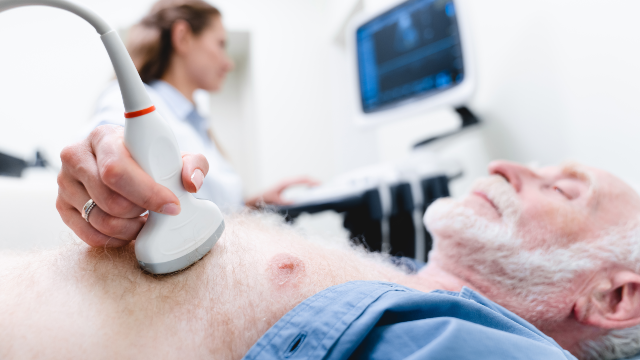
- Carotid ultrasound, used to look for plaque in the neck arteries — a direct window onto atherosclerosis and an input into stroke risk discussion.
- Cardiac ultrasound, which assesses heart structure and pumping function.
- Abdominal ultrasound, which examines the abdominal organs and, depending on the protocol, the abdominal aorta.
- Laboratory analysis using ATELLICA immunology, AU680 biochemistry, and XN1000 hematology analyzers, covering the lipid, glucose, liver, and kidney measures that feed into risk estimation.
That last ultrasound category connects to a specific, well-defined recommendation. The U.S. Preventive Services Task Force recommends one-time screening for abdominal aortic aneurysm with ultrasonography in men aged 65 to 75 who have ever smoked, grading it a B recommendation, and notes that screening can reduce aneurysm-related death, rupture, and emergency surgery. For men in that age band who have never smoked, the Task Force recommends selectively offering the screening rather than performing it routinely. An abdominal aortic aneurysm is generally defined as aortic enlargement measuring 3.0 centimeters or more.
Ultrasound is minimally uncomfortable and uses no ionizing radiation. Abdominal imaging does require fasting for roughly eight hours beforehand so that bowel gas does not obscure the view.
Cancer Screening: Where the Evidence Is Strongest
Lung
The U.S. Preventive Services Task Force recommends annual low-dose CT screening for adults aged 50 to 80 who have a 20 pack-year smoking history and who currently smoke or quit within the past 15 years. The center offers Low-Dose CT Scan as a named service, performed on 128-channel MDCT hardware, with the scan itself taking under ten minutes. Eligibility criteria are more detailed than a single sentence can capture, and are worth working through with a clinician rather than self-assessing.
Colorectal
The Task Force recommends colorectal cancer screening for adults aged 45 to 75. It grades screening from 50 to 75 as an A recommendation, concluding with high certainty that the net benefit is substantial, and grades the 45-to-49 band as a B recommendation with moderate net benefit. From 76 to 85, the Task Force treats screening as an individual decision. Several methods qualify, including colonoscopy, high-sensitivity stool-based tests, CT colonography, and flexible sigmoidoscopy.
The Busan center performs sedation gastroscopy and colonoscopy using Olympus 290-series high-definition endoscopy equipment, with CO₂ insufflation, and can remove colon polyps during the same visit. Colonoscopy requires substantially more preparation than the rest of a checkup, so it needs to be planned rather than added on the morning of.
Prostate: A Decision, Not a Default
This is the component most often misunderstood, and it deserves a careful description.
The U.S. Preventive Services Task Force does not recommend routine PSA-based prostate cancer screening for all men. For men aged 55 to 69, it recommends shared decision making: an individual choice made after a conversation with a clinician about the potential benefits and harms. The Task Force concludes with moderate certainty that the net benefit in this age group is small for some men — PSA screening may slightly reduce the chance of dying from prostate cancer, but many men face harms including false-positive results that lead to further testing, and diagnosis of cancers that would never have caused symptoms or death. For men aged 70 and older, the Task Force concludes that the expected harms outweigh the potential benefits and advises against routine screening.
The National Cancer Institute's screening summary describes the same tension in similar terms. Family history, race and ethnicity, other medical conditions, life expectancy, and your own tolerance for uncertainty all legitimately shift the answer.
The practical implication for a screening trip is that PSA should not be silently included or silently excluded. If you want it, ask for the conversation that goes with it. If you do not, that is a defensible choice too.
Bone Density: Not Only a Women's Concern
Bone-density testing is available at the center, and it is worth understanding what the evidence does and does not support for men.
The National Institute of Arthritis and Musculoskeletal and Skin Diseases notes that osteoporosis is often thought of as a women's disease, but that some men — particularly those aged 65 and older — do develop it, and that fractures caused by fragile bones in men have increased in recent years. Men are also less likely than women to be evaluated for osteoporosis after a fracture, and less likely to receive treatment for it. NIAMS is candid that while the U.S. Preventive Services Task Force recommends DXA testing in women by age 65, the Task Force has found insufficient evidence to recommend routine DXA testing in men.
That makes bone-density testing a reasonable discussion point rather than an automatic inclusion — more clearly indicated for men with risk factors such as long-term glucocorticoid use, chronic disease, low sex hormone levels, heavy alcohol use, smoking, or a fracture after age 50.
Occupational Health: The Part Most Checkups Omit
For a substantial share of working men, the most significant health exposures happen at work, and a standard preventive checkup has no mechanism for detecting them.
The National Institute for Occupational Safety and Health, part of the U.S. Centers for Disease Control and Prevention, describes worker health and safety surveillance as the systematic examination of changes in work-related injuries, illnesses, and exposures over time, assessed by job and industry, in order to monitor known concerns and identify emerging ones. NIOSH runs targeted programs along these lines, including surveillance of work-related lead exposure and a long-running respiratory health program for coal miners.
The Occupational Safety and Health Administration draws a distinction that helps clarify what an occupational medicine consultation contributes. OSHA separates medical screening — evaluating an individual worker to detect early signs of a work-related condition — from medical surveillance, the analysis of health information across a group of workers to identify hazards that individual results would not reveal.
Yonsei Mirae IFC Medical Center's team includes Dr. Ju Su Hwan, a board-certified specialist in occupational and environmental medicine. He graduated from Dong-A University College of Medicine and completed his internship and his occupational and environmental medicine residency at Dong-A University Hospital, and is a regular member of the Korean Association of Occupational and Environmental Medicine. His consultation hours run weekdays from 8:00 AM to 6:00 PM and Saturdays from 8:00 AM to 12:30 PM, Korea Standard Time.
The value of that input during a screening visit is directional. Someone who has spent years around solvents, respirable dust, loud machinery, or rotating night shifts carries a different risk profile from someone who has not, and the examination selection should reflect it. The center also offers corporate and group health checkups, which is the context in which occupational input matters most.
What the Visit Looks Like
The center operates a one-day, one-stop screening model across approximately 6,600 square meters on the 2nd, 3rd, and 4th floors of IFC Mall at 133 Jeonpo-daero, Nam-gu, Busan, next to the BIFC subway station. A comprehensive checkup generally runs about 3.5 to 4 hours. The facility uses separated male and female movement routes through the checkup zones, along with a separate VIP patient flow, so the male pathway runs independently.
Screening hours are Monday through Friday, 7:30 AM to 4:30 PM, and Saturday, 7:30 AM to 12:30 PM, with the center closed on Sundays and public holidays. Preparation guidance asks patients to avoid strenuous exercise, overwork, and alcohol beforehand and to fast after 9 PM the night before; procedures such as colonoscopy require additional preparation. Programs are tiered from Basic through Platinum, and because scope varies by tier, the examination list and current costs are worth confirming directly when you arrange your appointment.
International patients are supported by a dedicated international medical center with a foreign-patient coordinator, English and Chinese interpretation, and reports, doctor's notes, and medical records prepared in English and Chinese. When a finding requires care beyond the center's scope, a One-Step referral system connects patients to the relevant department or to a higher-level general hospital, with follow-up management and phone-based result consultations. The center was founded in 2021, performs approximately 50,000 checkups annually, and holds certification as a Registered Medical Institution for Attracting Foreign Patients from Korea's Ministry of Health and Welfare — more background is available on the center's about page.
The Bottom Line
- A comprehensive male checkup bundles cardiovascular assessment, cancer screening, metabolic laboratory work, and — where relevant — occupational health input into a single sequenced visit rather than four separate referrals.
- The American Heart Association's PREVENT equations estimate 10-year and 30-year cardiovascular risk for adults aged 30 and older, giving clinicians and patients a shared basis for prevention discussions.
- The USPSTF supports annual low-dose CT for eligible adults aged 50 to 80 with a significant smoking history, colorectal screening from age 45 to 75, and one-time abdominal aortic aneurysm ultrasound for men aged 65 to 75 who have ever smoked.
- PSA testing is explicitly a shared decision for men aged 55 to 69 and is not recommended routinely for men aged 70 and over; it should be discussed, not quietly bundled in.
- At Yonsei Mirae IFC Medical Center, the male set includes cardiovascular pulse-wave analysis, low-dose CT, carotid, cardiac and abdominal ultrasound, bone-density testing, laboratory analyzers, endoscopy, a separated male patient route, and access to an occupational and environmental medicine specialist.
Frequently Asked Questions
How long does a comprehensive male checkup take?
At this center, a comprehensive checkup generally takes about 3.5 to 4 hours within a one-day, one-stop model. A national health insurance checkup takes roughly 1.5 to 4 hours depending on which examinations are included. Programs that include sedated endoscopy require additional time and preparation.
Should I include a PSA test?
That is a decision to make with a clinician rather than a default inclusion. The U.S. Preventive Services Task Force recommends shared decision making for men aged 55 to 69 after a discussion of benefits and harms, and recommends against routine screening for men aged 70 and older. Family history, other health conditions, and your own view of the trade-offs all influence the answer.
Does a normal checkup mean I am healthy?
No. A screening program lowers the probability that a particular condition is present at the time of testing, but it cannot exclude disease, and results should be read alongside your symptoms and history. New or persistent symptoms after a normal checkup still warrant medical attention.
What preparation is required?
General guidance is to avoid strenuous exercise, overwork, and alcohol beforehand and to fast after 9 PM the night before. Abdominal ultrasound requires fasting for roughly eight hours so that organs can be imaged clearly, and colonoscopy requires a separate bowel preparation regimen that must be planned in advance.
Why would I need an occupational medicine consultation?
Because work exposures shape risk in ways a general checkup does not capture. NIOSH describes occupational surveillance as tracking work-related illnesses and exposures by job and industry, and OSHA distinguishes screening an individual worker from analyzing health data across a workforce. If your job involves dust, chemicals, noise, or shift work, that context should influence which examinations are selected.
Is bone-density testing useful for men?
It can be, but it is not a universal recommendation. NIAMS notes that osteoporosis does occur in men, particularly from age 65 onward, while also noting that the U.S. Preventive Services Task Force has found insufficient evidence for routine DXA testing in men. It is most reasonable for men with specific risk factors, which is worth discussing before the visit.
Can I get my results in English?
Yes. The center provides English and Chinese interpretation through a dedicated international medical center and prepares examination reports, doctor's notes, and medical records in English and Chinese. Result consultations are also available by phone after you return home.
What happens if something abnormal is found?
The center provides follow-up management including prescription and treatment services, and operates a One-Step referral system connecting patients to relevant departments or to higher-level general hospitals when a finding requires more specialized care. Sharing the English-language report with your own physician is the sensible next step.
This article is for general informational purposes and does not constitute individualized medical advice, and it is not a self-diagnosis tool. Screening options, test selection, and the meaning of any result can only be determined through consultation with a qualified physician.
More Articles
Continue reading our clinical guides.
Is a 3.0T MRI Health Screening Safe? Radiation, Contrast
What MRI screening safety really involves: no ionizing radiation, gadolinium contrast risks, implant disclosure, pregnancy advice and claustrophobia help.
Learn More
Low-Dose CT Lung Cancer Screening in Korea: Who Qualifies
Who should consider low-dose CT lung screening in Korea: age and smoking criteria from the USPSTF and ACS, trial evidence, risks, and follow-up planning.
Learn More

Combining a Health Checkup and GI Screening in Korea
How to combine a health checkup and colonoscopy in Korea on one trip: what the shared fast covers, how the day runs, and real limits of a combined visit.
Learn More