Busan IFC Mall (2F–4F) · 6,600㎡ One-Day Comprehensive Health Screening & Specialist Care · International Patient Concierge
Breast & Thyroid Care · Consultation for Pricing
Breast & Thyroid Ultrasound
Ultrasound produces images by sending sound waves into tissue and reading what returns, in real time and without radiation.
Schedule a ConsultationBreast & Thyroid Ultrasound
Medically reviewed by Dr. Kim Seung-il, breast and thyroid specialist and lead of the Breast & Thyroid Center at Yonsei Mirae IFC Medical Center
Breast ultrasound in Busan and thyroid ultrasound use high-frequency sound waves to produce real-time images of tissue without any ionising radiation. At Yonsei Mirae IFC Medical Center the same modality serves two different purposes: for the breast it is the examination that handles what mammography cannot, and for the thyroid it is the primary imaging examination rather than a supplement to anything. This page covers both, and the difference between them.
What Is Breast and Thyroid Ultrasound?
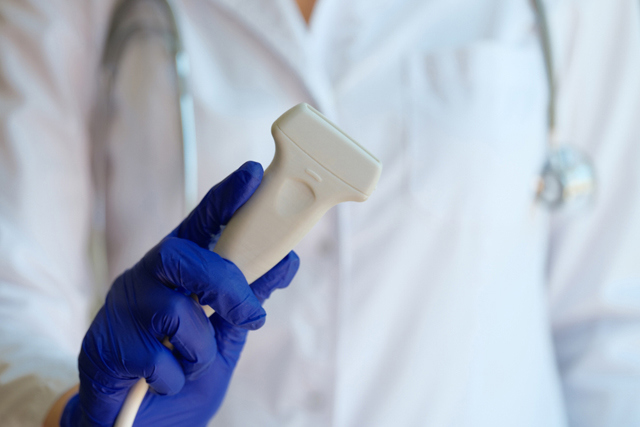
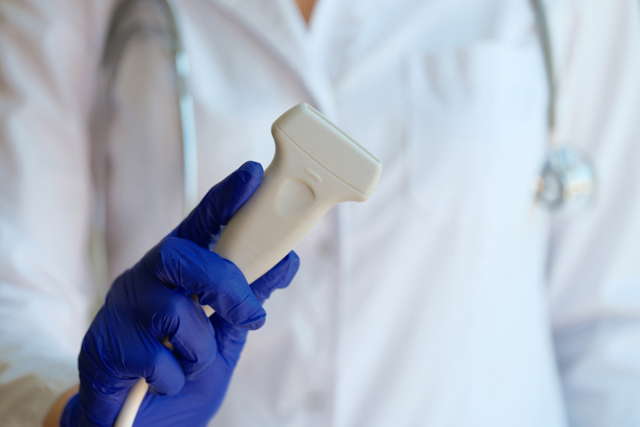
Ultrasound produces images by sending sound waves into tissue and reading what returns, in real time and without radiation. The examination is external — a probe moved across the skin with gel between — and the images appear as the examination is being performed rather than afterwards.
- Breast ultrasound is particularly useful for assessing dense breast tissue, tissue asymmetry and masses.
- Thyroid ultrasound evaluates the gland itself and detects and characterises nodules and tumours, including whether a nodule is solid or cystic and whether it has changed size since a previous examination.
- The clinic distinguishes the two breast examinations directly: mammography uses radiation, breast ultrasound uses sound waves, and each shows lesions the other may not.
- The systems in use are the GE S8, the Aplio 500 and the Aplio 300 — described as producing cross-sectional tissue images with high penetration and high-resolution, real-time visualisation.
- No radiation is involved at any point, which is why the examination can be repeated for follow-up without a dose consideration.
The breast and thyroid roles are documented differently in the wider literature, and the distinction is worth carrying into the appointment. For the breast, the National Cancer Institute notes that breast ultrasound may be offered in addition to mammography for people with dense breasts, but that it is not known whether this supplemental screening leads to better health outcomes. For the thyroid, the position is more settled: the National Institute of Diabetes and Digestive and Kidney Diseases describes thyroid ultrasound as the imaging test most often used to examine thyroid nodules, helping indicate whether a nodule is more likely to be cancerous, and as the test used to guide the needle during fine needle aspiration biopsy.
Who Performs Breast and Thyroid Ultrasound at Yonsei Mirae IFC Medical Center
Yonsei Mirae IFC Medical Center documents this service as being overseen by the physician named above rather than documenting that one individual personally performs every appointment, so the member of the clinical team you see on the day is determined by scheduling. Dr. Kim Seung-il is documented as a breast and thyroid specialist and as the lead of the clinic's Breast & Thyroid Center. The clinic publishes no licence, board certification, education or training details for him, and this page claims none. Ultrasound differs from most imaging in one respect that is relevant here: it is operator-dependent, because the images depend on how the probe is held and where it is directed at the moment of the examination. The clinic documents its Breast & Thyroid Center and its equipment; it does not publish individual operator credentials, and a patient for whom that matters can ask before booking.
Ultrasound Options and What Each Examines
One modality, two distinct examinations, with different relationships to the tests around them.
| - | Breast ultrasound | Thyroid ultrasound |
|---|---|---|
| Role | Complementary to mammography | The primary imaging examination for the gland |
| Strongest for | Dense tissue, tissue imbalance, characterising masses | Gland shape and size, nodule detection and character |
| Distinguishes | Lesions mammography may not resolve | Solid from cystic nodules; change in size over time |
| Paired with | AI-assisted mammography | TSH, Free T4 and T3 thyroid-function testing |
| Radiation | None | None |
The pairing logic differs between the two. Breast ultrasound is paired with a second imaging test because the two see different things; thyroid ultrasound is paired with blood tests because imaging and function are different questions entirely. A thyroid ultrasound cannot tell you whether the gland is working correctly, and a thyroid-function panel cannot tell you whether there is a nodule in it.
Who Is a Good Candidate for Breast and Thyroid Ultrasound?
- Patients undergoing routine breast or thyroid screening.
- People with a palpable breast lump or another breast abnormality.
- Women with dense breasts requiring supplemental imaging.
- Patients with a suspected thyroid nodule, or with a known nodule requiring follow-up.
- Patients with thyroid-related symptoms or abnormal thyroid-function test results.
- Patients for whom mammography is unsuitable, including during pregnancy or lactation, where breast ultrasound can be performed instead.
What to Expect: Procedure, Recovery, and Results Timeline
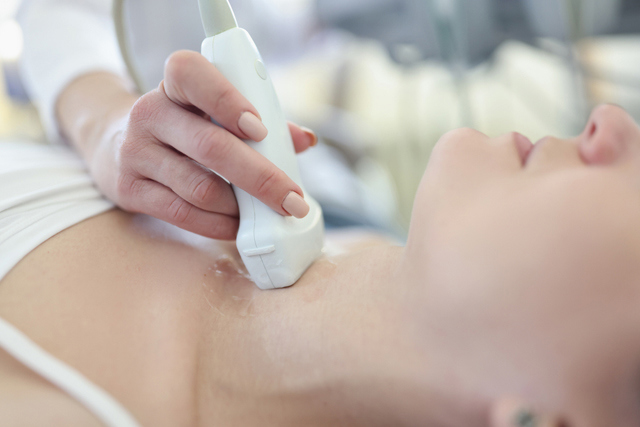
Fasting is not required for ultrasound examinations of the breast, thyroid, carotid artery and certain other areas. The clinic reviews medical history and current physical condition, selects the appropriate examinations, performs the imaging and evaluates the findings. No anaesthesia is used: these are external examinations. Gel is applied and the probe is moved across the skin, which is generally minimally uncomfortable, though mild pressure may be felt — particularly over a tender breast lump or a sensitive area of the neck. A focused ultrasound examination commonly takes around 10 to 30 minutes, depending on the area examined, the number of findings and whether additional images are needed; performed together as part of a comprehensive checkup, the overall appointment takes longer. No recovery period is required and normal activities can resume immediately: there is no incision, no injection, no radiation and no anaesthesia to recover from. No special aftercare is normally necessary, though patients should review the findings and follow any recommendation for repeat ultrasound, mammography, laboratory testing, specialist consultation or another diagnostic procedure.
| Stage | What to expect |
|---|---|
| Preparation | No fasting required for breast, thyroid or carotid ultrasound |
| Anaesthesia | None; the examination is external and non-invasive |
| During | Gel applied, probe moved across the skin; generally minimally uncomfortable, mild pressure possible |
| Duration | Around 10–30 minutes for a focused examination; longer within a full checkup |
| Images | Produced in real time, so the examiner assesses the structures as the examination proceeds |
| Recovery | None; immediate return to normal activity |
| Aftercare | None required; review findings and follow any recommendation for further testing |
| Travel | Generally possible after the examination if you otherwise feel well |
Because the images appear in real time, the person performing the examination is assessing the structures as they go — which is why an ultrasound often produces an immediate impression even though the formal report follows the clinic's usual process.
Combining Ultrasound with Other Examinations
Ultrasound is the examination most often added to something else, and the clinic documents both directions.
- Breast ultrasound combines with AI-assisted mammography, particularly where additional assessment is needed or where breast density limits what the mammogram can show.
- The clinic's women's screening programme includes breast observation alongside mammography.
- Thyroid ultrasound combines with TSH, Free T4 and T3 thyroid-function testing, pairing structure with function.
- Precision thyroid ultrasound is included in the clinic's checkup packages, with breast-related screening depending on the package selected.
- Where ultrasound identifies a lesion that imaging alone cannot characterise, it is also the examination used to guide a biopsy needle.
What the clinic offers around the examination is a dedicated Breast & Thyroid Center rather than ultrasound as a standalone service, with the complementary imaging and the wider screening infrastructure in the same building. In practice that means a supplementary examination suggested by an ultrasound finding does not require a separate referral elsewhere.
Safety, Precision, and Clinic Standards
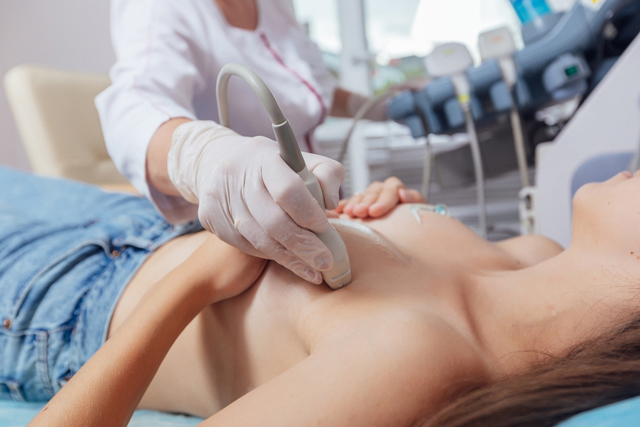
Diagnostic ultrasound uses sound waves rather than ionising radiation, so there is no radiation exposure from the examination. Routine breast and thyroid ultrasound generally has no significant side effects; the most common temporary issue is mild pressure or tenderness from the probe, and patients may feel discomfort where the area being examined is already painful or sensitive. The clinic documents several high-resolution ultrasound systems — the GE S8, the Aplio 500 and the Aplio 300 — described as providing real-time imaging with high penetration and high-resolution images. Its broader diagnostic infrastructure, including the 3.0T MRI and the 128-channel MDCT scanner, is available within the same facility where a finding needs a different modality. Yonsei Mirae IFC Medical Center operates as a licensed Korean medical clinic under the Medical Service Act.
What ultrasound does not do is worth stating as clearly as what it does. It characterises a lesion; it does not diagnose one. A nodule described as solid, or as having grown since the last examination, is a nodule that may warrant sampling — the ultrasound has narrowed the question rather than answered it. The same applies on the breast side: a mass seen on ultrasound has been found and described, not identified.
The clinic describes a One-Step model in which a finding can be routed the same day to an in-house department, or fast-tracked to a partner tertiary hospital.
The International Medical Center at Yonsei Mirae IFC Medical Center provides English-language support for international patients, and the clinic states that this assistance runs from consultation through recovery.
The Bottom Line
- Ultrasound produces real-time images using sound waves, with no ionising radiation and no preparation required.
- For the breast it is complementary to mammography and particularly useful in dense tissue; for the thyroid it is the primary imaging examination.
- Thyroid ultrasound characterises a nodule — solid or cystic, stable or changing — and is also the examination used to guide a biopsy needle.
- A focused examination takes roughly 10 to 30 minutes, needs no anaesthesia and requires no recovery.
- It narrows the diagnostic question rather than settling it; a lesion found on ultrasound may still need tissue sampling.
Frequently Asked Questions
**Do I need to fast before an ultrasound?**Not for these examinations. The clinic states that fasting is not required for ultrasound of the breast, thyroid, carotid artery and certain other areas. If the ultrasound is part of a wider checkup that includes blood tests or endoscopy, that programme's own instructions apply.**Does it hurt?**Usually not. Gel is applied and the probe is moved across the skin, which most people find minimally uncomfortable. Mild pressure can be felt, and it may be uncomfortable over a tender breast lump or a sensitive part of the neck — but there is no needle, no compression and no anaesthetic.**How long does it take?**A focused ultrasound examination commonly takes around 10 to 30 minutes, depending on the area, the number of findings and whether extra images are needed. If breast and thyroid ultrasound are performed together within a comprehensive checkup, the appointment as a whole runs longer.**Is there any radiation?**None. Diagnostic ultrasound works by sending sound waves into tissue and reading the reflections. This is the main practical difference from mammography and from CT, and it is why ultrasound can be repeated for follow-up without a cumulative-dose consideration.**Why is ultrasound recommended if I have dense breasts?**Because dense tissue limits what a mammogram can show, and ultrasound is particularly useful for assessing it. The two examinations detect different findings, which is the clinic's stated reason for using them together rather than choosing between them.**What can a thyroid ultrasound tell me about a nodule?**Its shape, its size, whether it is solid or cystic, and whether it has changed since a previous examination. Those characteristics inform whether sampling is warranted. What the ultrasound cannot do is establish what the nodule is; that requires tissue.**Can I have this done during pregnancy?**Breast ultrasound can be performed during pregnancy or lactation, which is one reason it is the examination used when mammography is unsuitable. As with any examination, tell the medical team about pregnancy so the rest of the visit can be planned around it.When can I travel after the examination?
Straight away, in general. Routine ultrasound is non-invasive, requires no anaesthesia and has no recovery period, so patients can usually fly home after the examination if they otherwise feel well and no further procedure is planned.
Book a Consultation at Yonsei Mirae IFC Medical Center
Whether you need breast ultrasound, thyroid ultrasound or both depends on what is being looked for, so it helps to say when booking. Enquiries and appointments go through the clinic's enquiry and booking page, or by telephone on . The Breast & Thyroid Center and the clinic's ultrasound systems are described further on the clinic's About Us page.
Yonsei Mirae IFC Medical Center is located on the second, third and fourth floors of IFC Mall, 133 Jeonpo-daero, Nam-gu, Busan, South Korea. Health screening runs Monday to Friday from 7:30 AM to 4:30 PM and Saturday from 7:30 AM to 12:30 PM, Korean Standard Time. Consultations run Monday to Friday from 8:00 AM to 6:00 PM and Saturday from 8:00 AM to 12:30 PM. The clinic is closed on Sundays and public holidays.
Disclaimer
This page is provided for informational purposes only and does not constitute medical advice, diagnosis or treatment. Whether any test or procedure described here is appropriate for you depends on your own medical history and can only be decided in consultation with a qualified physician.
Sources & Further Reading
- Screening for Breast Cancer — National Cancer Institute, U.S. National Institutes of Health
- Thyroid Tests — National Institute of Diabetes and Digestive and Kidney Diseases, U.S. National Institutes of Health
Related Medical Services
Explore additional diagnostic examinations and specialist treatments available at Yonsei Mirae IFC Medical Center.
Life-Cycle Checkup Program
The Life-Cycle Checkup Program is a set of age- and life-stage-specific screening packages — pre-marital couples and senior citizens are the two examples the clinic names — designed so that the examinations a person...
Learn More

Fatigue Recovery Clinic
The Fatigue Recovery Clinic at Yonsei Mirae IFC Medical Center provides a structured medical assessment for persistent tiredness or low energy. Fatigue evaluation in Busan here means examining the possible contributing...
Learn More
Upper GI Series
An upper GI series uses swallowed contrast and X-ray imaging to assess structural and functional abnormalities of the oesophagus, stomach and duodenum. The clinic describes it as an indirect examination, in contrast to...
Learn More